Shape the Future of
Our Profession
HKIST Standards Review 2026 — Join the public consultation and help define the next generation of professional standards for Speech Therapists in Hong Kong.
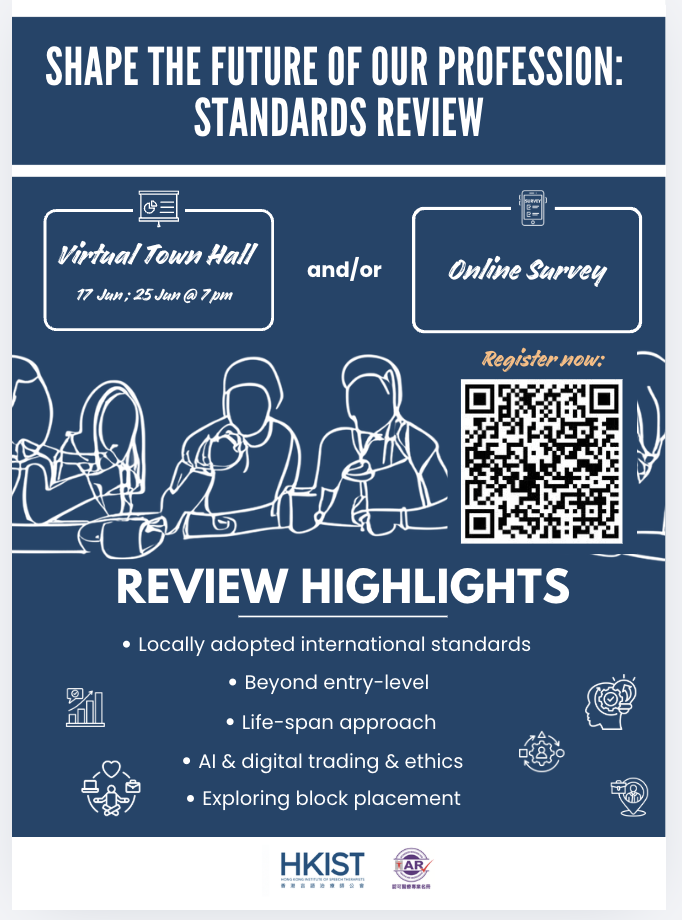
Watch the Overview
A quick introduction to the HKIST Standards Review 2026 and what it means for practitioners in Hong Kong.
Why This Review Matters
Five pillars define the new framework — modernising how speech therapists practise, learn, and grow in Hong Kong.
Global Alignment
Locally adopted international standards from Speech Pathology Australia, validated across Mutual Recognition Agreement (MRA) signatory countries.
Career Lifespan
Standards that go "Beyond Entry-Level" — defining accountability and quality across every stage of a therapist's career.
Modern Ethics
Explicit integration of AI tools and digital ethics, including guidelines on social media conduct and client data protection.
Clinical Innovation
Exploring block placement in non-programme settings and simulated clinical training to expand workforce readiness.
Life-span Approach
A unified spectrum of client care across the lifespan, removing rigid pediatric/adult distinctions.
Major Changes at a Glance
The new Professional Standards represent a significant structural and content upgrade from the Competency Based Occupational Standards (CBOS) 2011 framework.
Framework Transition
Transitioning from CBOS 2011 to Speech Pathology Australia's Professional Standards (PS), which covers communication and swallowing across the entire lifespan and supports whole-of-career accountability — not just entry-level minimums.
Structural Reorganisation
Two core documents (Code of Ethics + Standards) will be complemented by Best Practice Guidelines and Position Papers — enabling agile updates on emerging topics (AI, social media) without a full standards overhaul.
AI & Digital Ethics
Explicit inclusion of AI tools to facilitate service delivery, with clear requirements for client confidentiality, identity disclosure when sharing content online, and ethical use of technology.
Educational Standards Update
The 300 clinical hour requirement is retained, with up to 40% via simulation. Block placements in non-programme settings are encouraged, and 25% direct live supervision is clarified. Latest legal updates (e.g., Mandatory Reporting Ordinance) now recommended in curriculum.
Your Expertise Is Needed
The Expert Panel has identified five key areas where practitioner feedback will shape the final standards.
Simulation in Clinical Training
What is an acceptable ratio of simulation to direct client contact? What Quality Assurance (QA) measures define "valid" simulation?
Immersive Block Placements
Should block placements in non-programme settings be mandatory for accreditation? Is it feasible for all institutions?
AI & Technology in Practice
Do the proposed Best Practice Guidelines sufficiently balance AI efficiency with data privacy and over-reliance risks?
Informed Consent Logistics
How can rigorous informed consent be maintained without hindering high-volume administrative workflows?
Managing Linguistic Diversity
Does the standard on using interpreters or technology provide sufficient flexibility for therapists serving ethnic minorities?
Ready to contribute?
Submit your feedback via the anonymous online survey or attend a virtual Town Hall on Wednesday, 17th or Thursday, 25th June.
The Review Roadmap
A transparent, step-by-step journey to publishing the updated standards.
- ✓Model Search by Registration Committee✓ Completed
- ✓Internal Drafting & Review by Registration Committee✓ Completed
- ✓Expert Panel Review✓ Completed
- 4Field Review & Public Consultation▶ Current Phase
- 5Consolidation of Feedback— September 2026Upcoming
- 6Final Implementation— Q4 2026Upcoming
About the Review Panel
The review was conducted by the HKIST Registration Committee with an Expert Panel comprising 16 experienced practitioners — NGO representatives from adult and pediatric settings, and private-sector specialists. Formal governmental consultation is conducted in parallel with the Hospital Authority, Department of Health, and Education Bureau.
Frequently Asked Questions
Common questions about the review process and what's changing.
Why is the CBOS framework being replaced?+
The CBOS 2011 framework no longer reflects the current global landscape. On January 1, 2021, Speech Pathology Australia officially replaced CBOS with the new Professional Standards (PS). The update moves beyond entry-level competencies to support practitioners at all career stages.
Why was the Australian Professional Standards framework selected?+
The PS eliminates rigid age-based distinctions, covers communication and swallowing across the lifespan, emphasises cultural and linguistic diversity (essential for Hong Kong), and aligns with the foundation of local university curricula — ensuring a seamless upgrade for training institutions.
How many documents will the new standards comprise?+
Two core documents — the Code of Ethics and the new Standards for Speech Therapists in Hong Kong (with Scope of Practice integrated). These are supplemented by Best Practice Guidelines, Position Papers, and the Institutional-Based Assessment for education programmes.
What is the significance of simulation in clinical training?+
Simulation addresses placement constraints, provides exposure to specialised and high-risk cases, and builds foundational competency in a safe environment. Up to 40% of the required 300 clinical hours may be fulfilled through accredited simulation.
When will the new standards be officially published?+
The new professional standards are scheduled for formal publication in Q4 2026, following the consultation period and feedback consolidation.
What is a virtual Townhall, and why not a traditional consultation forum?+
A virtual Townhall is an interactive, online gathering designed to foster direct, two-way communication between HKIST and our stakeholders. Rather than a formal, one-way presentation, it provides an open platform for the drafting committee to share the vision behind the new Standards, and for participants to ask questions, share immediate impressions, and engage in real-time dialogue.
By contrast, a traditional Consultation Forum is typically a highly structured, formal setting dedicated to a systematic, clause-by-clause technical review of drafted documents.
Because it is impossible to conduct such a meticulous and detailed technical review within a brief 2-hour online session, we intend to deliver the function of the consultation forum through our Online Survey instead. The survey serves as our digital forum, providing you with the necessary time to examine the text closely and submit precise, section-specific feedback.
Consultation Documents
Review the full detail before completing the survey.
Stay Connected
Don't miss the virtual Town Halls — your chance to present feedback in real time and engage directly with the Registration Committee.
Questions? Contact the HKIST Secretarial Support Team